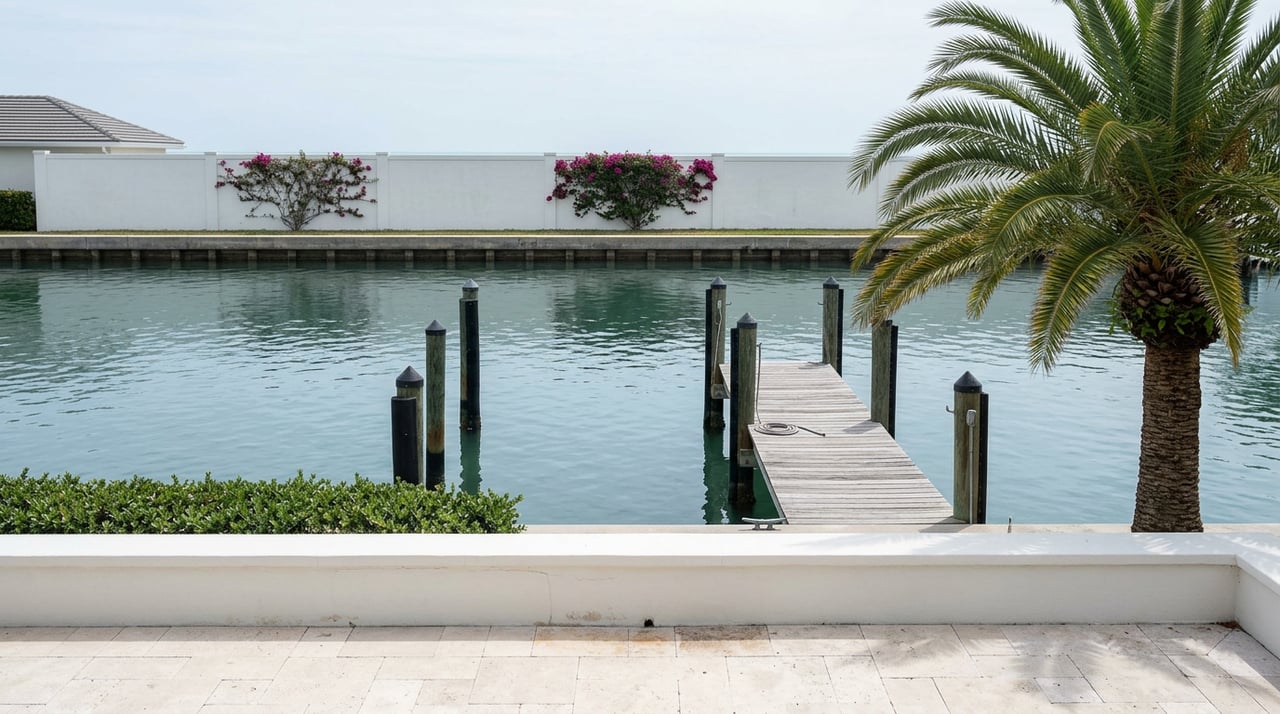
Close of escrow on a Newport Beach waterfront home comes with a form most buyers never see coming. It asks for the seller's signature and the buyer's signature, side by side, and it has to reach the City of Newport Beach's Public Works Department before the dock behind the house is legally the new owner's to use. Nobody hands over a key to a private slip the way they hand over a house key. The dock is a permit, tied to a piece of land the city itself is now being told it has been underpricing for years, and 2026 is the year that pricing starts to change.
That distinction, permit rather than property, is the thing a Newport Harbor buyer needs to understand before writing an offer, not after.
The Paperwork Waiting at the Closing Table
A residential pier permit is issued to the owner of the adjoining upland parcel, not to the dock as a standalone asset, and it runs for a set term rather than forever. When a home sells, that permit does not travel with the deed automatically. Both the buyer and seller have to submit a transfer application with complete information, and their signatures are due at close of escrow, along with the transfer fee, to the City's Public Works Department. Turnaround typically runs five to fifteen working days, and the process includes a physical inspection of the pier. If the dock does not meet the City's current safety standards, the applicant gets a letter listing what has to be corrected before staff will sign off, and the permit only transfers once the City has original signatures from the seller, the buyer, and any joint permittee on file.
None of this shows up on a listing sheet. It shows up in escrow, usually when someone assumes the dock is simply included and finds out there is a separate government process standing between them and using it.
Why the Number on That Permit Is About to Move
Here is the part that makes 2026 different from any other year to buy on the water in Newport Beach. In December 2025, the California State Lands Commission issued a report reviewing how the City manages Newport Harbor's tidelands, and its central finding on residential docks was blunt: the City is not charging fair market rent for the piers sitting over land the state owns. According to reporting on the underlying staff analysis, the current residential pier rate works out to about 58 cents per square foot, and fair market value may run close to double that.
The City's own response, laid out on its public tracking page for the harbor review, commits to a specific sequence: new independent appraisals of residential piers and other user groups conducted through 2026, a series of Harbor Commission public meetings beginning in spring 2026, a draft policy package expected in winter 2026 into 2027, and a comprehensive City Council vote in 2027. The City has also stated plainly that no rate increases or transfer restrictions take effect without Council approval and public notice, so nothing changes overnight.
What this means for a buyer right now is simple to state and easy to miss. The annual pier rent a seller quotes today is a snapshot of a number the state has already flagged as too low, mid-appraisal, with a policy vote still a year or more out. Treat that figure as a starting point for budgeting, not a fixed carrying cost, and ask for it in writing rather than assuming it holds.
The Mooring Story Is Rougher
Piers are attached to a specific home. Moorings are offshore, unattached to any parcel, and for years the most common way to get one in Newport Harbor was a private transfer between boaters, often for a sale price running into the tens of thousands of dollars. The same December 2025 State Lands Commission report recommended the City end that practice entirely and develop a transition plan for current holders.
The rate side of the mooring story moved first. Reporting from January 2026 describes state commissioners finding no issue with the appraisal the City used to justify a mooring rate increase, even as the same commissioners flagged residential pier rates as too low by comparison. Under the changes the City has proposed, the current rate of $3.34 per linear foot per month, or roughly $133 monthly for a 40-foot mooring, would rise to somewhere near $15 per linear foot, or about $600 a month for that same 40-foot mooring, and the new license structure would be month to month rather than transferable.
If a Newport Beach listing markets a private mooring as though it were a private asset that simply comes with the property, that claim deserves more scrutiny than a residential pier permit does right now. The pier program is being reappraised. The mooring transfer program itself may not survive in its current form.
The Water Behind the House Is Not Uniform
Two homes on the same street, with identical square footage and identical frontage, can be meaningfully different assets depending on what sits in the water behind them. The pierhead and bulkhead lines that determine how far a dock can extend, and therefore how large a vessel a property can berth, were established for Lower Newport Bay by an act of the United States Congress and can only be changed the same way. A parcel with a generous gap between those two lines can accommodate a larger boat than a parcel next door with a tighter one, and that gap does not show up in square footage.
Balboa Island is its own case. City code is explicit that no new noncommercial piers are permitted there unless the Harbor Commission finds one to be in the public interest, which in practice makes an existing permitted dock on the island considerably more valuable than the prospect of adding one later. A handful of areas, including Beacon Bay, the Balboa Bay Club, and Harbor Island, also carry historic state legislation that modifies how public trust restrictions apply, which is reason enough for a title review before contingencies come off in those pockets.
Maintenance carries its own quiet cost. Newport Bay silts in over time, and when a slip loses depth, the work and expense of dredging the area between a homeowner's extended side property lines and the federal project line typically falls to the harbor permittee, not the City.
A Few Questions Worth Asking Before You Remove Contingencies
Does the pier permit transfer automatically when I buy a waterfront home? No. It requires a separate application signed by both buyer and seller at close of escrow, a City inspection, and typically five to fifteen working days to process. Build that timeline into escrow rather than assuming the dock is simply included with the house.
Can I get a new dock if the property doesn't already have one? It depends heavily on location. On Balboa Island, new noncommercial piers are not approved unless the Harbor Commission finds one to be in the public interest, so an existing permit there should be weighted as a genuine scarcity, not a minor amenity.
Will the pier rent go up before I close? Not without City Council approval and public notice, which the City has stated directly. But the reappraisal driving that eventual number is already underway, so a buyer should plan for an increase over the next year or two rather than assuming today's rate is permanent.
Waterfront value in Newport Harbor has always depended on more than the house. It depends on a permit, a set of surveyed lines nobody can move without an act of Congress, and right now, a state-mandated review that is actively rewriting what that permit costs. Getting the price of the home right matters. Getting the paperwork behind the dock right matters just as much, and 2026 is not the year to treat that paperwork as a formality.
If you are evaluating a Newport Harbor property, whether it has a pier permit already in place or you are weighing what one might cost to acquire or transfer, Emilia Schiller can help you read the current picture clearly before you write an offer. Let's Connect.